Triple Match 3D
- 4.4
- Rating
- 10.00M
- Installs
- Free
- Price

 Analysis by App-foxy
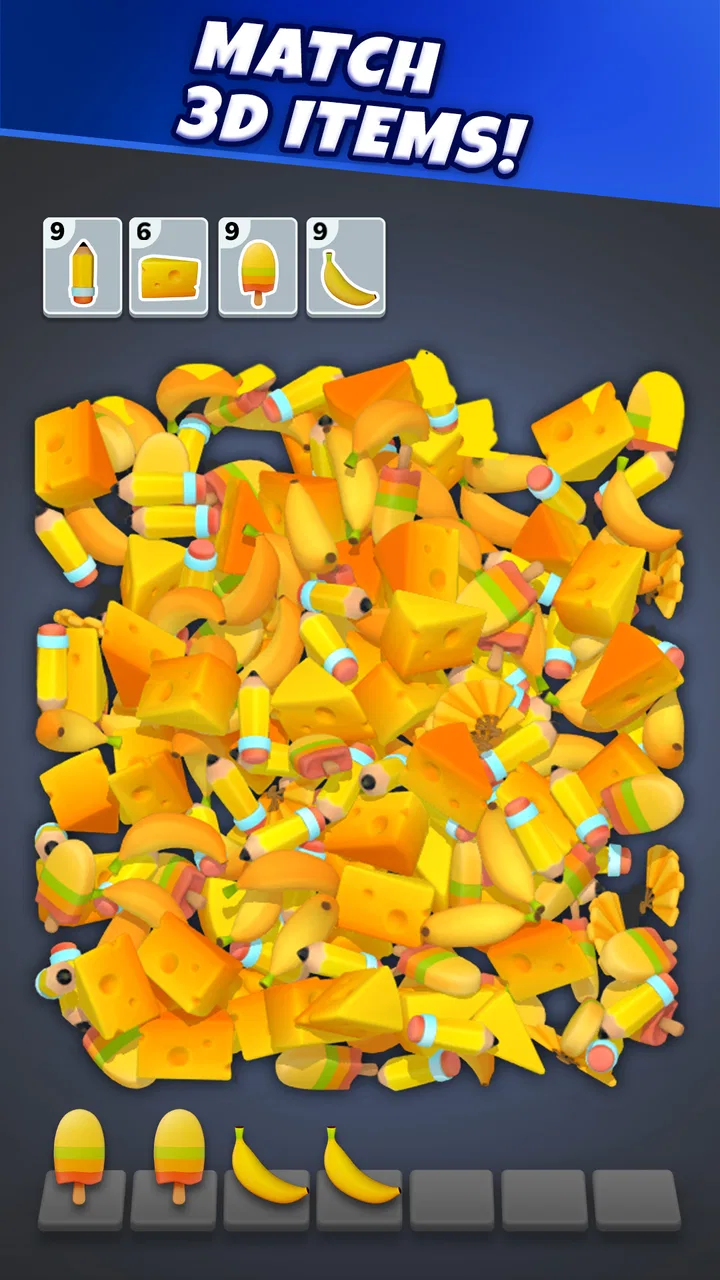
I found Triple Match 3D easiest to understand when I treated it as a shared, low-pressure puzzle rather than a game demanding a long uninterrupted session. The basic task is simple: look through a crowded three-dimensional scene, find three matching objects, and clear them. That sounds familiar, but the depth and clutter make each board more about visual searching than ordinary tile matching. I can play for a few minutes while waiting, then hand the phone to someone else without needing to explain a complicated story or control scheme.
That makes this free puzzle game from Boombox Games LTD particularly comfortable in a household where people use the same device at different times. It is listed for Everyone, runs on Android 7.0 or later, and has reached over 10 million installs. Its average rating is 4.5 from around 87 thousand ratings, which fits my impression that the central loop is immediately approachable, even though the experience will not suit every kind of player.
How the shared puzzle loop works in everyday use
I find the shared puzzle loop easiest to enjoy when we agree on a simple turn-taking rule: scan a different part of the scene, suggest a trio, then let the other person decide whether to tap it. That keeps the search collaborative without pretending the game is built around formal teamwork. It also sets up the next question: what makes each match feel satisfying enough to invite another turn?
You May Also Like

 Blood Strike: 2.5 Anniversary
Blood Strike’s Loadouts Turn Every Drop Into a Tactical Gamble
A close look at Blood Strike’s custom loadouts: how fast access to signature weapons reshapes its battle royale rhythm, rewards preparation, and narrows the gap between fights.

 Pandora - Music & Podcasts
Pandora’s Music Is Easy to Start, but Harder to Recover
Pandora’s strength is its low-effort path from a seed to a station. Its weak spot is how much confidence it asks you to place in connection, setup, and quiet recovery.

 8 Ball Pool
 Is Built on Rivalries, Rematches, and Routine
A close look at the rivalries, rematches, shared routines, and unanswered safety questions that turn a quick pool match into a persistent mobile community.

 Samsung Music
’s Quiet Strength Is Playing What You Already Own
Its reach comes less from spectacle than from dependable access to a personal library. That simplicity is both the app’s strongest retention engine and its ceiling.

 AccuWeather: Weather Radar
AccuWeather Review: A Quick, Clear Forecast for Everyday Decisions
For everyday plans, the best forecast is the one you can understand quickly. AccuWeather makes rain timing, radar, and local conditions easy to act on, with a few trade-offs.

 Hill Climb Racing
Why Hill Climb Racing Still Turns Crashes Into One More Run
A tiny car, a bumpy hill and one more upgrade: Hill Climb Racing keeps resurfacing because its simple chaos makes every near-miss feel personal.
More From Our News Desk



A game that works when the phone is passed around
In my experience, the strongest household use case is the short turn. One person can search a board, make a few matches, and stop. Another player can pick up the device and continue looking without having to remember a character build, a map position, or a chain of story decisions. The visual objective is always clear enough to understand from the screen: identify groups of three objects and remove them.
I can imagine this working well during a quiet evening when two people are sitting together but do not want to commit to a competitive board game. One person points out a likely match, the other taps it, and the search becomes a small cooperative activity. It is not true multiplayer coordination, and I would not mistake it for a game designed around shared accounts or team progress. Its value is more informal: the device can move between people, and the puzzle remains readable.
The three-dimensional presentation changes the rhythm compared with a flat match-three board. Objects overlap visually, and the challenge comes from noticing what is available rather than simply planning a chain across a grid. I found that this rewards patience more than speed. If I rushed, I was more likely to tap an object that looked similar but did not belong to the group I had in mind. Slowing down and scanning one section at a time was usually more effective.
Why the travel theme helps, and where it becomes secondary
The game frames its mini-games around travel, but the lasting appeal for me is not the theme alone. The travel setting gives the boards a changing sense of place and helps prevent the object-search task from feeling like one repeated screen. Still, the puzzle mechanics remain the main reason to return. Players looking for a deep travel simulation, a narrative journey, or meaningful destination management should look elsewhere.
I also noticed that the theme makes the game easier to show to another person. A child or casual player can understand the scene without learning a ruleset full of exceptions. An adult who normally avoids puzzle games may be willing to try one round because the visual presentation feels lighter than a traditional strategy title. That accessibility is useful in a shared home, but it also means experienced puzzle players may eventually want more complexity than the basic search-and-match loop provides.
Small sessions are better than forced marathons
This is the kind of game I would keep available for spare moments, not use as my only evening entertainment. The repeated visual scanning can become tiring, especially when I play for too long without a break. The best routine is to finish a short stretch, put the phone down, and return later with fresh attention. That is also convenient when several people share the device, because nobody has to reserve it for a long block of time.
One practical tip is to agree on a simple handoff habit: finish the current board or clear the immediate set of matches before passing the phone on. Without that small bit of coordination, another player may inherit a cluttered screen and wonder which objects were already being considered. This is not a formal feature of the game, just a useful way to make a casual shared session less confusing.
What I would check before installing it on a shared device
The download itself is free, which lowers the barrier for trying it. However, the game includes in-app purchases ranging from $0.49 to $204.99 per item. That range is important in a household, particularly when children or guests may use the same device. I would decide in advance who is allowed to make purchases and review the device’s purchase protections before handing it over.
I would also keep the game’s current version in mind: it is version 182.04. That is useful when troubleshooting with another person, because everyone should be using the same installed build if a screen or behavior looks different. The minimum operating-system requirement is Android 7.0, so an older Android phone may not be suitable even though the game itself is easy to understand.
On iOS or Android, the most important boundary is not the puzzle rule but the device boundary. A shared phone can blur who is playing, who is progressing, and who is responsible for any purchase prompt. I would not assume that a casual puzzle automatically separates family members into independent spaces. If several people need clearly isolated progress, a game with explicit profiles or separate accounts would be a safer choice.
Keeping turns understandable without inventing a family system
Because the game is built around visual matching, coordination can stay simple. A parent and child can take turns searching different areas of the same board, or one person can call out a possible trio while the other checks it. The important distinction is that this is cooperation around one screen, not a built-in household management tool. I would describe it as a shared activity, not as a family platform.
For a group, I would set expectations before starting. Decide whether players are helping one another or taking independent turns, and agree that a mistake is part of the puzzle rather than a reason to blame the previous player. That sounds obvious, but the crowded three-dimensional scenes can make people feel they have “lost” an object when it was simply hidden among other items. A calm search method keeps the activity pleasant.
Another useful approach is to give each player a role. One person can scan the left side of the scene while another watches the right, then they can compare possible matches before tapping. This makes the visual clutter feel more manageable and gives younger players a way to participate even when they are not as quick at spotting small details. It also turns a solitary puzzle into a light conversation without requiring a multiplayer mode.
Age suitability is about context as well as the label
The Everyone content rating reflects the approachable nature of the puzzle. There is no need to understand complex language, combat systems, or a long fictional backstory before playing. That makes it a reasonable candidate for a mixed-age household when an adult is comfortable with the device arrangement and purchase boundaries.
Even so, I would not treat an age label as a complete supervision decision. The in-app purchase range means adults should handle payment settings responsibly, and younger players may need help understanding why a useful-looking option costs money. The game’s visual simplicity can make it attractive to children, but simplicity of play does not remove the need for ordinary device supervision.
Trust also matters between users. If one person is expected to preserve another person’s progress, agree on that before passing over the phone. A player who taps quickly or starts a new activity may change the experience for the next person, even without intending to. Since the game is convenient to share physically, I would use it on a device where everyone understands the limits of that sharing.
Where it differs from other puzzle choices
Compared with a classic flat match-three game, this one puts more emphasis on object recognition and spatial scanning. A conventional grid usually lets me plan moves by looking at rows, columns, and possible cascades. Here, the main question is often, “Where is the third object?” That makes it a better fit for someone who enjoys visual search, but a weaker fit for someone who wants deep chain planning or carefully calculated board control.
Compared with a hidden-object game, the matching rule gives the search a clearer action loop. I am not merely locating items from a list; I am building groups of three and clearing them. On the other hand, players who prefer a rich mystery, detailed scenes, or a strong narrative payoff may find the matching structure too repetitive. The travel framing adds flavor, but it does not turn the game into an exploration adventure.
It also differs from competitive puzzle games because the appeal is not primarily about defeating another person in real time. That is why I think it works better for a household looking for a calm shared pastime than for friends who want a tense head-to-head contest. If your priority is a leaderboard, direct competition, or a strict personal-best chase, another puzzle category may serve you better.
Three habits that make the search less frustrating
First, I avoid scanning the entire board randomly. I divide the scene into zones and inspect one zone for possible pairs or trios before moving on. This reduces the chance of repeatedly overlooking the same object. It is especially helpful when a board contains many similar shapes or colors.
Second, I do not spend every move on the most obvious object. Clearing an easy trio can reveal or visually separate other items, so I think about whether a match will make the remaining scene easier to read. The game is still accessible, but this small bit of sequencing gives the basic loop more texture than blind tapping.
Third, I treat visual fatigue as a signal to stop rather than a challenge to push through. When my attention drops, I make more errors and enjoy the puzzle less. A short break is often more useful than trying to force the last few matches. This is one reason the game fits waiting rooms, short commutes as a passenger, or brief household breaks better than extended sessions.
What may limit its appeal
The core activity is deliberately narrow. If you dislike searching crowded scenes, the three-dimensional presentation will not rescue the experience; it may make the task feel busier. Players who need constant mechanical variety, character progression, or a substantial story may run out of reasons to continue sooner than casual puzzle fans.
The free entry point is convenient, but the presence of paid items changes how I would recommend it for a shared device. I would be comfortable suggesting a trial to an adult who knows how to manage purchases. I would be more cautious about leaving it available to a child without discussing the payment boundary first. That is not a criticism of the matching mechanic, but it is a real part of the ownership experience.
I also would not choose it as the main game for a household that needs separate identities and clearly protected progress. A title with explicit profiles, stronger account separation, or more direct cooperative tools would be better for that purpose. Triple Match 3D works best when people are sharing a screen informally and are willing to coordinate their turns themselves.
My household verdict
After spending time with it, I see this as a friendly, easy-to-start puzzle for visual search rather than a deep strategy game. The three-dimensional boards give the familiar matching idea a more tactile feel, and the travel setting makes the presentation pleasant without overwhelming the simple objective. I especially like that someone can join for a short turn without needing a tutorial about a complicated world.
I would recommend it to adults who want a free casual game, families looking for a screen-based activity they can discuss together, and puzzle players who enjoy spotting patterns in clutter. I would skip it if I wanted competitive multiplayer, a substantial story, or a puzzle system built around long-term strategic planning. I would also choose a different option when separate household accounts are essential.
My final advice is to install it with realistic expectations: it is a compact matching pastime, not an all-purpose family hub. Set the purchase boundaries first, decide how progress will be shared, and use short turns to keep the search enjoyable. With those limits understood, Triple Match 3D becomes a pleasant choice for passing the phone around, relaxing for a few minutes, and letting different ages enjoy the same simple visual challenge.
FAQs for Triple Match 3D
01What is Triple Match 3D and how does it work?
Triple Match 3D is a captivating puzzle game where players match three identical 3D objects to clear them from the board. The game challenges your visual perception and strategic planning as you progress through increasingly complex levels. It’s perfect for those who enjoy engaging and visually stimulating puzzles.
02Is Triple Match 3D free to play, and are there in-app purchases?
Triple Match 3D is free to download and play, offering a range of levels without initial cost. However, the game includes optional in-app purchases for items like boosters or extra lives, which can enhance gameplay. These purchases are not required to complete the game but can provide added convenience.
03What devices are compatible with Triple Match 3D?
Triple Match 3D is available for both Android and iOS devices. It supports a wide range of smartphones and tablets, ensuring smooth gameplay across different platforms. Always check the app store for the latest compatibility requirements to ensure optimal performance on your device.
04How does the game ensure user privacy and data security?
Triple Match 3D adheres to strict privacy policies, ensuring user data is handled with care. The app collects minimal personal information, primarily for improving user experience and gameplay. Users can review the privacy policy in the app’s settings or on the developer’s website for full transparency.
05Can I play Triple Match 3D offline, or do I need an internet connection?
Triple Match 3D can be played offline, allowing users to enjoy the game without an internet connection. However, some features like in-app purchases and leaderboard updates require connectivity. Playing offline enhances accessibility, making it a great option for travel or areas with limited internet access.
Pros
- Engaging 3D puzzles enhance the gaming experience.
- Smooth graphics and animations.
- Daily challenges keep gameplay fresh.
- Intuitive controls for easy play.
- No intrusive ads interrupting gameplay.
Cons
- Limited levels may feel repetitive over time.
- In-app purchases can be pricey.
- Requires constant internet connection.
- Occasional lag on older devices.
- Battery consumption is higher than average.

Triple Match 3D
Gallery